Drilling & Completion Tech Digest
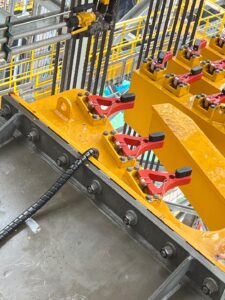
New offshore deployment for fingerboard monitoring
Salunda announced a successful deployment of its Latch Hawk monitoring system on a semisubmersible in the Americas deepwater region. The installation was completed earlier this year.
Integrated with the drilling control system on the rig, Latch Hawk provides real-time feedback on the status of fingerboard latches located within the drilling derrick, acting as a critical safety barrier to DROPS incidents on drill floors.
“This latest deployment is part of a broader rollout across the region, which highlights the positive reception our technology continues to receive,” said Alan Finlay, Salunda CEO.
The fingerboard monitoring solution removes the need for manual spotters or camera surveillance. It provides confirmation of the status of each latch, warning if latches are stuck or out of specification, helping crews proactively address issues and avoid equipment failures.
This recent deployment featured the second-generation Latch Hawk system, which includes advancements such as novel sensor technology, enhanced shock and vibration resistance, a more robust casing design, cloud-based digital condition monitoring and an extended battery life of more than seven years.
Earlier this year, Salunda also expanded the use of its safety technologies in Guyana with the installation of its Crew Hawk Red Zone monitoring systems on four drilling platforms. These systems combine accurate, low-latency personnel tracking with dynamic zones around active machinery.
Fluid system engineered to address zinc bromide challenge in HPHT reservoir
Responding to an operator’s need for a 14.5-ppg density drilling fluid system that would be compatible with zinc bromide – a solution that standard systems typically do not support – Halliburton delivered a fluid system for the high-pressure, high-temperature (HPHT) reservoir (344°F bottomhole temperature) with a filter cake tolerant with zinc bromide.
After initial lab testing, the BaraDrilN X Generation III reservoir drill-in fluid system and the new BaraFLC W-1096 polymer were deployed in the US Gulf. The solution helped the operator achieve zero downhole losses and maintain wellbore stability throughout the 69-hour wireline campaign. After a 48-hour contact period with zinc bromide, the gravel pack was executed, demonstrating the fluid’s long-term stability and compatibility.
The system also exhibited high gas tolerance and withstood gas levels up to 1,185 units without compromising performance.
While drilling through 332 ft of cement, there were no adverse effects on fluid properties. The fluid system remained tolerant of zinc bromide and contributed to improved wellbore stability and integrity.
AI-powered ‘engineer’ gains upgraded capabilities
Norway-based Pions has introduced the next generation of Ida, an AI-powered “engineer” with new levels of advanced reasoning and inference capabilities, as well as the capability for enhanced complex task management.
Ida now features an extractor that boosts its adaptability and generalization, allowing it to tackle complex, real-world environments with increased confidence and efficiency.
Ida is capable of taking care of simulations, an often time-consuming part of an engineer’s work, using proprietary dynamic transient modeling; and data search and retrieval, analysis (e.g., DDRs, EOWRs), and reporting (progress and performance). Ida can also now be seamlessly integrated with other tools and workflows, enabling usage to be scaled quickly.
Automation, AI technologies help Eni to push ROP record
Eni is reporting improvements in its drilling performance following the integration of digital, AI and automation technologies into well planning and operations. In Q1 2024, the operator completed its first fully autonomous deployment offshore West Africa. The operator was able to set a global ROP record of 1,224 m per day, reduce reaming and circulation before connection, and decrease weight-to-weight time by over 50%. Further, when tripping in cased hole, Eni has reached up to 26 stands per hour.
Several advanced solutions from SLB contributed to these achievements. DrillPlan helped with well planning, while DrillPilot allowed drill floor machines to be operated in one optimized sequence. This reduced the need for personnel on the rig floor during pipe-handling operations. DrillOps was used to autonomously manage different drilling phases, while Neuro solutions enabled autonomous steering.