Environment, Social & Governance
Report: Coal demand could stay higher for longer
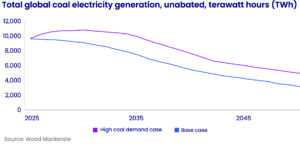
Global coal demand could remain stronger for longer, with coal-fired power generation potentially staying dominant through 2030, well beyond current projections for Peak Coal, according to a new report from Wood Mackenzie. It suggests that there is a confluence of factors that could extend coal’s role as a vital power source well into the next decade and beyond.
These factors include a rapidly electrifying global economy; energy security priorities rising from geopolitical and cost shocks; and Asia’s young and evolving coal fleet. Nations are increasingly prioritizing energy sovereignty and domestic resource control to support their long-term objectives, the report noted.
“Extending coal’s prominence through 2030 would fundamentally alter the global energy transition timeline,” said Anthony Knutson, Global Head, Thermal Coal Markets at Wood Mackenzie. “We’re talking about delaying the phase-out of the world’s most carbon-intensive fuel source during a critical decade for climate action.”
In Wood Mackenzie’s base-case Energy Transition Outlook, coal-fired power generation is projected to decline by nearly 70% between 2025 and 2050. This decline is driven by decreasing renewable energy costs, advancements in battery storage technology, a resurgence in nuclear energy, and an increase in natural gas capacity. However, the new report highlights that there is potential for coal demand to be stickier than expected.
Under the high coal demand case, output from global coal fleets is optimized to help meet steep and rapid load growth expectations, leading to significantly less renewable and gas energy deployment. This equates to 2,100 GW less global natural gas, wind, solar and energy storage capacity between 2025 and 2050.
Without carbon capture and storage investment, unabated emissions from the coal sector would increase by 2 billion tonnes compared with the base case scenario.
The report also notes that a higher coal demand case will expose investment gaps in replacement coal supply, potentially raising prices by 2030. That would erode the fuel’s core cost advantage and, eventually, future demand.
There is also a potential for carbon capture, utilization and storage to transform coal’s environmental profile, by capturing carbon dioxide emissions before they enter the atmosphere. However, the economics of doing so would remain challenging without substantial policy support and capital investment.
“Our high coal demand case is not a forecast, but it’s a warning of what inaction could bring, and a reminder of what can still be prevented,” said David Brown, Director, Energy Transition Practice at Wood Mackenzie.
JIPs result in software upgrades for low-carbon technology implementation
DNV has released a new version of its advanced computational fluid dynamics simulation software, developed through three joint industry projects (JIPs) with energy companies. The software enables safer and more effective implementation of key low-carbon solutions.
Accurate simulations of gas dispersion, fire and explosions are crucial for the deployment of energy transition solutions, such as carbon capture, utilization and storage (CCUS), hydrogen and ammonia. KFX software models the behavior of liquid or gaseous materials and predicts their potential consequences in real environments in the event of accidents. These simulations are used as the basis for design of installations, to mitigate consequences and for quantitative risk assessments.
The latest KFX release introduces specialized consequence modeling of carbon dioxide (CO2), ammonia (NH3) and hydrogen (H2), with unique capabilities that reflect the physical properties and thermodynamics of each fluid. The new features were developed over four years in collaboration with Equinor, TotalEnergies, Vår Energi and Horisont Energi.
“Through these joint industry projects, we’ve worked side by side with leading energy companies to decode the complexities of the energy transition, translating that knowledge into scalable software that supports the safe and effective deployment of CCUS and other critical technologies related to hydrogen and ammonia,” said Kenneth Vareide, CEO of DNV Digital Solutions.
For CO2 releases, the software now predicts the formation of dry ice and the sublimation of particles in the air or from the ground if deposited. This could impact the gas cloud and affect necessary safety distances in facility planning.
Existing dispersion, combustion and radiation models in KFX have undergone extensive testing and validation for hydrogen and hydrogen mixtures. EXSIM, the gas explosion solver within the software, has also been enhanced for better prediction of hydrogen explosion effects.