IADC ART Committee revives Spark Tank series to foster drilling technology innovation
AI-enabled cuttings analysis, 3D-printed bits among ideas, products pitched to panel of operator, driller and service company ‘sharks’

By Stephen Whitfield, Senior Editor
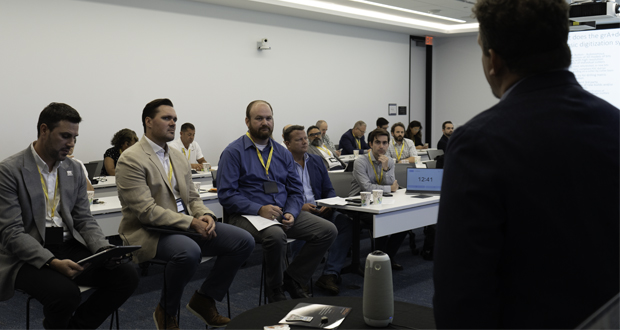
On 27 August, the IADC Advanced Rig Technology (ART) Committee revived its Spark Tank series after a three-year hiatus. The forum, modeled after the TV show “Shark Tank,” provides technology innovators operating in the drilling space with an opportunity to pitch their ideas and products to a panel of industry experts.
Priority is given to individual inventors and small/emerging companies that may not have the resources to exhibit at industry events or invest in marketing campaigns. Participation at the event, therefore, allows them to receive technical and business feedback directly from the types of companies that might be the end users of the technologies being pitched.
This year’s Spark Tank featured pitches on four technologies: an automated shale shaker monitoring system, a digital drill bit grading system, the use of 3D printing for drill bits, and an AI-based platform for knowledge management.
Three industry experts served as “sharks” providing feedback to the speakers: Jeff Walker, Automation Specialist at BP; Paul Sullivan, Innovation Portfolio Manager at Noble; and Matt Rayson, Director of Product Management at Caterpillar Oil & Gas. The current ART Committee Co-Chairs – Trent Martin, Senior Engineer with Transocean, and Alex Groh, Data Science Manager with Patterson-UTI, moderated the event.
DrillDocs: Drill cuttings analysis
Calvin Holt, Co-Founder and CEO of DrillDocs, showcased an automated shale shaker monitoring system, CleanSight, that uses computer vision to analyze drill cuttings. Images captured at the exit of each shaker are interpreted automatically to identify cuttings and cavings, quantifying their size and shape. This functionality, Mr Holt said, can provide valuable inputs to drilling-related simulations and onsite decision making.
“We’re trying to improve hole cleaning and the detection of problems that can manifest with the shaker,” he said. “There’s a lot of invisible lost time that the industry currently accepts. As long as we get out of hole and get some casing down, we’re happy, but maybe we could have cost ourselves an hour, or maybe a couple of days, or maybe you get stuck in hole and you lose the BHA. Let’s prevent that lost time.”
Drilling engineers rely on hydraulic models and cuttings transport models that can become more inaccurate as wellbore depth and complexity increase. While engineers follow best practices to analyze these models, these best practices are not foolproof. Without a reliable system to effectively measure hole-cleaning performance, drillers run the risk of nonproductive time (NPT) and stuck pipe incidents that can be costly to remediate, especially when the well must be plugged back and sidetracked.
The CleanSight system uses industrial cameras embedded with edge computing servers to extract images of the cuttings as they exit the shale shaker. Those images are then processed through native software that analyzes the size and shape of the cuttings.
The software detects and reports anomalous objects, which might include cavings indicating borehole instability, or debris that might indicate a part of the BHA is failing.
The software can also monitor shaker performance to detect uneven loading or overflow conditions that can damage equipment. It then classifies the cuttings from these anomalies, which Mr Holt referred to as “unidentified falling objects.” The estimated shaker load data, as well as configurable alerts noting the presence of these falling objects, are then delivered to the driller’s console, where the driller can determine if any remedial action needs to be taken.
“Essentially, this is an AI-enabled computer looking at each shaker,” Mr Holt said. “We translate the pixels into data that we present in video form and in a dashboard. We’re getting a much better look into the path of how things are falling.”
As of August 2025, the system was being deployed on four offshore rigs, and Mr Holt said DrillDocs hopes to scale that to between 12 and 15 offshore rigs over the next year.
Trax Electronics: Automated dull grading
Sean Emery, Global Product Line Manager for Trax Electronics, discussed the development and commercialization of the company’s digital drill bit grading system, grA+de. The system, launched in 2020, uses photogrammetry to scan dull drill bits and build high-resolution 3D models of these bits that can be viewed from anywhere in the world.
AI algorithms perform assessments of the wear and damage on each individual cutter, as well as the body of the bit. The algorithms are also calibrated for wear and damage pattern recognition, allowing drillers to correlate that data with drilling data to identify dysfunctions.
The system’s development originated from work Trax was performing on a separate drilling optimization software program, Mr Emery said. “In working on this software, we were having some issue with our beta version because of the grades we were getting of the drill bits. These codes are subjective, they’re inconsistent, they’re biased. We came to the conclusion that we needed something digital that could provide consistent analysis, so we built it.”
The system uses a robotic atomic scanner to take pictures of a used bit and transmits those images wirelessly to a software program incorporating AI algorithms. Those algorithms generate a 3D visualization of the bit, which can then be manipulated in the grA+de 3D viewing software.
The software can provide wear measurements, IADC dull grades and percentages of diamond and cutter loss. That data can then be exported in a text format and applied against forensic EDR data to define forensic failure modes and identify potential improvements to the bit design that could optimize drilling performance.
The software filters data sets by cutter, manufacturer and the date of operation, enabling real-time analysis of how specific drilling operations affect bit wear. It also includes heat mapping functionality, allowing for drillers and OEMs to make side-by-side comparisons of drill bits and identify trends in damage profiles.
The system is currently deployed on 14 land rigs, primarily in Canada, the UAE and the Permian Basin, although Trax is continuing to explore new markets.
Texas A&M University: 3D printing of PDC bits
PDC bit manufacturing is a big business, with thousands of bits used to drill wells around the world every year. However, it can also be a costly business, involving a time-intensive manufacturing process. PDC bits are made by producing cutters through a high-pressure, high-temperature powder metallurgy sintering process, with the cutters being welded onto a steel or tungsten carbide body with a low-temperature solder.
Finding a way to make the manufacturing process cheaper and less time intensive, therefore, could be extremely valuable to drillers and manufacturers, said Justin Jones, a petroleum engineering graduate student at Texas A&M University. Especially in a market where capital discipline is paramount and tariff concerns could affect supply chain costs, a streamlined manufacturing process could potentially lead to significant cost and time savings.
“If you work in China, Canada, Argentina, or anywhere else that’s dealing with unconventional wells, you’re always looking at ways to lower costs and be more effective in what you’re doing, and we’re about to face some realities with various political moves. Tariffs are hanging over our heads. We see the challenges with material manufacturing methods, and when we find challenges, we need to find innovative solutions,” Mr Jones said.
At the Spark Tank event, Mr Jones discussed a project the university is conducting around additive manufacturing, or 3D printing, of PDC bits. He asserted that a 3D printer would be able to produce a drill bit in two to three days, versus four to five days with a conventional process.
The 3D printing process has already made a noticeable impact on several industries, including oil and gas, as it enables manufacturers to prototype a number of equipment components regardless of their geometrical complexity. The process, which involves a 3D printer stacking layers of material on top of one another based on a digital model to create the final product, enables significant lead time reduction and cost savings by allowing users to produce parts as needed. This eliminates the need to keep stockpiles of various parts made through a conventional manufacturing process.
The 3D printing process has been around for decades, but only in the last few years have companies in more industries begun successfully producing metal components to operate in high-pressure, high-temperature environments – similar to the downhole conditions in which PDC bits operate. Mr Jones cited SpaceX as an example – in 2019, that company began using its SuperDraco thruster, which features a 3D-printed engine chamber, on the maiden voyage of the Dragon 2 spacecraft. The chamber for that thruster was regeneratively cooled and printed in Inconel, a high-performance superalloy.
The A&M project is still in the research and development phase, where researchers are designing prototype bits with various metals. The next phase will involve the testing of prototypes with a laboratory-scale drilling rig to verify hydraulic performance. From there, the project would move to shallow well testing – Mr Jones said the researchers would ideally target a 2,000-ft well depth for an initial test. If the well test and lab performance align, the project would then move to a deep well test, perhaps around 10,000 ft.
While these tests have not been scheduled, Mr Jones said he estimates it will take approximately three years to go from laboratory testing to completing a deep well test.
KnowledgeBox – Documentation platform
The costly lost-time incidents that can hamper a drilling campaign are often rooted in the simplest of issues – fragmented documentation, gaps in knowledge of important procedures, and communication barriers between rig crew members. As part of the Spark Tank event, Charlie Cubitt, Founder and CEO of KnowledgeBox Solutions, presented an AI-based cloud computing software platform designed to mitigate these issues, putting every piece of documentation surrounding a given operation at the fingertips of any crew member who needs to access it.
“If you look at these incident reports, you’re seeing the same things over and over: lack of procedures, deficiencies in management of change, lack of training and competence, inadequate risk assessments and planning, communication failures, failures to disseminate lessons learned. This is what we’re tackling with our solution,” Mr Cubitt said.
The software is a Windows application that provides rig crews with access to manuals, response plans, certificates, incident reports, safety reports and any documented lessons learned from incidents.
In developing the software, KnowledgeBox prioritized having an interface that ensures that information is shared clearly and effectively. The software features a natural language interface that can translate documentation into any language.
“We wanted to build a system where guys can talk to it in their own language and get answers right away. If you talk in Spanish, you’ll get your information in Spanish. If you talk in English, you get information in English. It’s converting whatever documents you need on the fly,” Mr Cubitt said.
The system also features an intelligent shift handover module to help crew members share notes between shifts. Once a driller comes off shift, he or she can enter notes made about a given operation over the course of the previous shift. The module then compiles those notes and creates a formatted report that also includes well data and handover ties. This report is then signed by the outgoing driller and read and signed by the incoming driller.
“We’re creating a record of guided handovers stored in the database. A rig manager can look across the entire fleet and look at, for instance, how long it took to complete a pressure test over the past year. You can analyze why certain rigs were performing a certain test quicker,” Mr Cubitt said.
On top of creating records for the rig crews, the platform also contains training modules covering topics such as well control or handling specific pieces of equipment like mud pumps. These modules are optional, but Mr Cubitt said they are a valuable component for assessing the competencies of crew members. DC