



Posted on 19 March 2009 in News
After focusing on “people” during Tuesday’s plenary session at the 2009 SPE/IADC Drilling Conference in Amsterdam, the Wednesday session turned to another critical element: technology. The goal of the discussion – titled “Technology – Evolution or Revolution?” – was to look back on our historical journey at technology delivered by both evolution and revolution and to discuss opportunities for such technologies in the future.
Moderator Lance Cook of Shell began the session by reminding everyone that “the easy oil is gone,” and industry will need every innovation possible in order “to get hydrocarbons into the pipeline at the rates we need”.
Posted on 19 March 2009 in News
A wired pipe telemetry system helped reduce drilling time by 10% in an onshore project for Occidental Petroleum.
Wired pipe technology is here, said Chris McCartney with Occidental Petroleum, “and I’m here to tell you, get ready for it.”
In a presentation during the drilling automation session at the 2009 SPE/IADC Drilling Conference in Amsterdam on 18 March, Mr McCartney described how the use of wired pipe telemetry strings at Occidental of Elk Hills Inc (OEHI) in California helped to deliver an average 10% reduction in drilling time.
With mud pulse telemetry or electromagnetic data transmission, the process of receiving and processing the downhole measurements means there’s lag time. The data density of mud pulse telemetry points transmitted to surface is also reduced, with downhole measurements improving and requiring additional bandwidth.
Posted on 19 March 2009 in News
IADC vice president-drilling & well services division David Reid of NOV detailed work by the IADC Advanced Rig Technology (ART) Committee to study top-drive reliability and survey tech trends for the future. Mr Reid made his remarks during the opening of the Wednesday, 18 March, plenary session at the 2009 SPE/IADC Drilling Conference in Amsterdam. Mr Reid is also chairman of the IADC ART Committee.
The group, he noted, has five subcommittees. The Future Technology Subcommittee, under the leadership of vice chairman Frank Springett, NOV, has nearly completed development of an extensive survey on performance and future development for a host of drilling and completion technologies, covering both rig and downhole equipment. The survey will be made available to the industry soon.
Posted on 19 March 2009 in News
According to a study of well incidents on the UK continental shelf from 1999 to 2008, the majority of those incidents were due to geological factors and not readily preventable. Most were also efficiently handled, said Donald Dobson of the UK regulatory agency Health & Safety Executive (HSE).
Yet that’s no reason for the industry to settle into complacency, he added, during a presentation at the 2009 SPE/IADC Drilling Conference on 18 March in Amsterdam.
Posted on 19 March 2009 in News
To ensure continued relevance to new-hires in the petroleum industry, IADC’s RigPass Review Panel has revised the RigPass Accreditation Program curriculum. Specifically, modules for general safety principles, material handling and first aid were expanded, while a new wellsite environmental protection module was added. Additionally, an optional land endorsement module was created.
Emphasis on the employee’s responsibility for his/her own safety and the safety of co-workers permeates the entire revised curriculum, said Brenda Kelly, director of the IADC accreditation & certification department (ACD).
Posted on 19 March 2009 in News
Image courtesy of Hercules Offshore
In the March/April issue of DC, Hercules Offshore and Maersk Drilling spell out innovative strategies that make a difference in HSE results, Maersk through a systems approach to improving environmental performance and Hercules through empowering personnel as “safety heroes.”
Early in 2008, Maersk launched its “Green Rig” project to improve its fleet’s environmental impact. The focus was fourfold – energy efficiency and emissions, discharges, accidental spills, and waste management.
Posted on 19 March 2009 in News
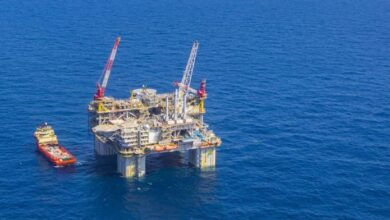
Shell’s Perdido development, with a drilling/production platform on top of a 555-ft spar, is located in about 8,000 ft of water.
At its Perdido development, Shell has completed installation of the drilling and production platform atop a 555-ft cylindrical spar floating in about 8,000 ft of water 200 miles from Houston in an isolated sector of the Gulf of Mexico. It is the deepest such facility in the world.
Russ Ford, Shell’s technology vice president for the Americas, said, “Perdido is a technological tour de force that is opening up a new frontier for global oil and gas production. Once the global economy recovers, the energy challenge will return with a vengeance, and new sources of energy will be required. Producing oil safely and responsibly this far out and this deep should allay concerns about industry access to the 85% of the US Outer Continental Shelf that remains undeveloped. Perdido and the OCS represent considerable potential to boost US and global energy security.”
Posted on 18 March 2009 in News
During the drilling boom of the last few years, when we couldn’t hire or train people fast enough, it seemed like our personnel challenges couldn’t get any tougher. Well, it turns out that they could – like if the global economy were to crash and rigs were to get stacked faster than we thought possible. How should the industry face the challenge of recruiting, training and retaining employees – a costly task – during these difficult economic times?
During the plenary session on the opening day of the 2009 SPE/IADC Drilling Conference, 17-19 March in Amsterdam, panelists from two IOCs, a drilling contractor and a service company engaged in a Q&A discussion session with the audience that raised tough questions – some that perhaps we don’t quite have an answer for yet.
Posted on 18 March 2009 in News
Citing the difficulties that operators face with downhole vibrations related to MWD and LWD equipment, Svein Magne Osnes with StatoilHydro called for the industry to establish a standard on the measurement/classification and reporting of vibration data, during his presentation at the 2009 SPE/IADC Drilling Conference on 17 March in Amsterdam.
No standard exists in the industry for downhole vibration testing, reporting or qualification, he said, and service companies have each developed different ways to measure and quantify downhole shocks and vibrations.
Posted on 18 March 2009 in News
Focusing on environmental performance during the HSE session of the 2009 SPE/IADC Drilling Conference, Dr Jerome Schubert of Texas A&M University presented the “661 Team Challenge” project that a graduate class undertook last year. Under that assignment, students used a systems engineering optimization protocol approach to incorporate current and emerging environmentally friendly technologies into a clean drilling system with no or very limited environmental impact.
The class challenge was done in conjunction with an ongoing project by the university in designing Environmentally Friendly Drilling (EFD) systems. Among other positive benefits, it helped to populate a database of environmentally friendly technologies that could limit drilling’s environmental impact.
21 May 2013
Leaders can achieve more in safety excellence by focusing on what they want employees to...
21 May 2013
Marshall Adkins, managing director of Raymond James & Associates, speaks with...
21 May 2013
Marathon Oil has determined that it may drill more than 3,000 wells in its Eagle...
21 May 2013
After a pilot program initiated in early 2011 to compare the use of LNG versus diesel to power...
21 May 2013
IADC is devoting significant energy and focus to address the interests of its onshore members...