Software: Out of sight, out of mind?
On the majority of drilling rigs today, “software” remains a largely invisible element of our operations that is out of sight, out of mind. If the top drive breaks down, we can see it and we can fix it. If a mud pump breaks down, we can see it and we can fix it. But what happens when software fails? That isn’t so easy to see, said Don Shafer, chief technology officer at Athens Group.
As a result, software-related LTIs are too often being mistakenly attributed to equipment failures. “We’re not talking about a lot of the issues that pertain to software,” he said during his presentation at the 2010 IADC Health, Safety, Environment & Training Conference in Houston on 26 January.
So why is the industry not recognizing these issues?
“Software is a relatively new phenomenon on rigs,” he explained. While software has been used in other industries like manufacturing, academia and the military since the 1940s and ’50s, rigs with large loads of software on them didn’t come into existence until the 1990s, he said. “We’re a little bit behind other industries in having that expertise.”
We have neither fully defined nor widely adopted mature systems and software engineering. Rig contracts don’t reflect software-related performance or safety needs. Factory acceptance and commissioning procedures don’t reflect software-related functionality. And industry incident-reporting forms don’t elicit software-related causes.
It also doesn’t help that software is nearly invisible, Mr Shafer said. For example, if you see the pipe handler drop pipe, you would report the incident as a pipe-handler problem. What you don’t see is the drilling control system (DCS) software that is managing the pipe handler, which is where the failure really occurred.
The outcome: QHSE initiatives are focused on pipe-handling equipment, not on software.
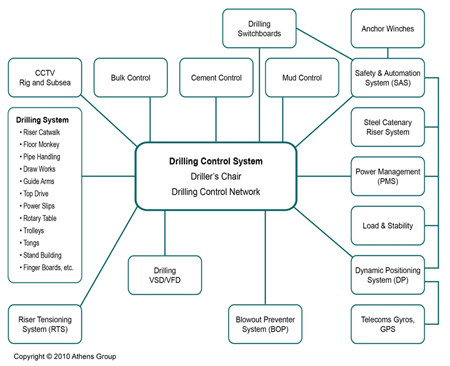
Mr Shafer noted that the most recent IADC Accident Statistics Program (ASP) Report showed that 57% of LTIs occurred on the rig floor – whether it was “struck by” or “caught between” or while tripping in or out. “What you have to keep in mind is that the drilling control system manages 75% to 95% of the movement on the floor,” Mr Shafer said.
To reduce LTIs, the industry must recognize software as a hidden cause and address it. He encouraged industrywide adoption and greater oversight of software quality processes and procedures and a consistent definition of equipment interfaces.
“You should also look at software engineering as a discipline to complement electrical, structural and mechanical engineering. Software engineering really exists … you have to take that engineering point of view.”
At the rig level, he urged companies to train their crews to recognize when DCS is the root cause so safety incidents can be accurately categorized. Software-related risk assessments and mitigation efforts should be increased throughout the life of the rig, and DCS and interface testing must be completed before rigs commence operations, not after.
Athens Group is conducting an online survey as part of a benchmarking study on NPT on highly automated offshore rigs.