Water-less fracturing among innovations for shale development

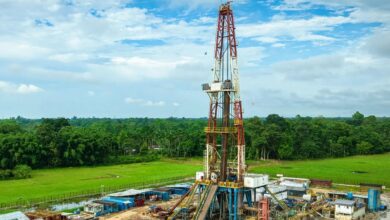
Economic recovery of gas from shale deposits requires the use of not only innovative completion technologies but also the use of manufacturing processes and environmentally friendly rigs, panelists said during a session at the IADC Oil and Shale Gas Drilling Technology Workshop held in Houston on 27 January.
According to Niels Meissner, advanced drilling solutions engineer for National Oilwell Varco; Vince Fortier, vice president sales and marketing for TTS Energy; and Robert Lestz, chief technology officer for Gasfrac Energy Services, there’s plenty of room for technological improvement in shale gas drilling and production, and each offered technological suggestions during the panel session.
Because shale development is a large-scale rather than a single-well activity, manufacturing technologies applied to drilling and production processes can offer economic and process improvement, said Mr Meissner, who offered an overview of manufacturing processes and how they might apply to shale development. In particular, he believes that Lean Producer and Lean Sigma Six process methodologies, already used in many other industries, can help shale operators to eliminate wasted time and material and allow for the delivery of made-to-order products and reduce costs while improving quality.
“I think we are operating at a Sigma level two,” Mr Meissner said. “My question to operators: Is that good enough?” He presented the audience with a three-year study conducted on a project in Southeast Asia in which the Lean Sigma process was implemented and resulted in a savings of approximately $1 million.
Also among Mr Meissner’s recommendations were the use of “walking” rigs when the environment allows it and the use of highly mobile rigs.
Mr Fortier discussed the need for environmentally friendly rigs for operations in urban environments, highlighting a rack and pinion rig working in the middle of a highly populated city in California. The rig is being used to perform lateral workover operations on more than 30 wells. This particular rig operation is surrounded by a compound wall to reduce sound and smell. It also has a modular design without a drawworks and has a traveling rack so no substructure is necessary. Vibration and ground loading are significantly reduced.
“We have the technology and the ability to set the benchmark right now,” Mr Fortier said. He also made recommendations for achieving a 30% reduction in personnel required on a rig through automating and performing operations offline, making real-time decisions and logging information at the rig level, operating off of a city’s power grid and performing simultaneous operations to get the most use out of the land.
Mr Lestz presented a new waterless approach to fracturing operations using liquid propane gas (LPG). He summed up the shale technology challenge as follows: how to get maximum rates and economics from low-permeability reservoirs, how to economically stimulate these reservoirs and how to minimize environmental impact.
“The ideal fracturing fluid should have properties to create a frac and then disappear, leaving no residue,” and a crosslinked LPG meets these criteria, Mr Lestz said. Use of LPG eliminates water use and allows the engineer to get 90% effective frac length.
Benefits of LPG, according to Mr Lestz, are that it handles as a liquid, is easily crosslinked, has low friction, acts like a viscoelastic type of fluid and disappears after the frac job. “It is sustainable, recyclable and widely available,” he said. The viscosity profile of LPG can also be tailored using breakers and crosslinkers.